YouTube Updates Partner Program Terms & Shorts Payout Rules: What Creators Need to Know in 2027
Published: August 2026
Category: YouTube Marketing / Social Media / Digital Marketing
YouTube is making significant changes to its YouTube Partner Program (YPP) that will affect both new creators and channels that are already monetizing.
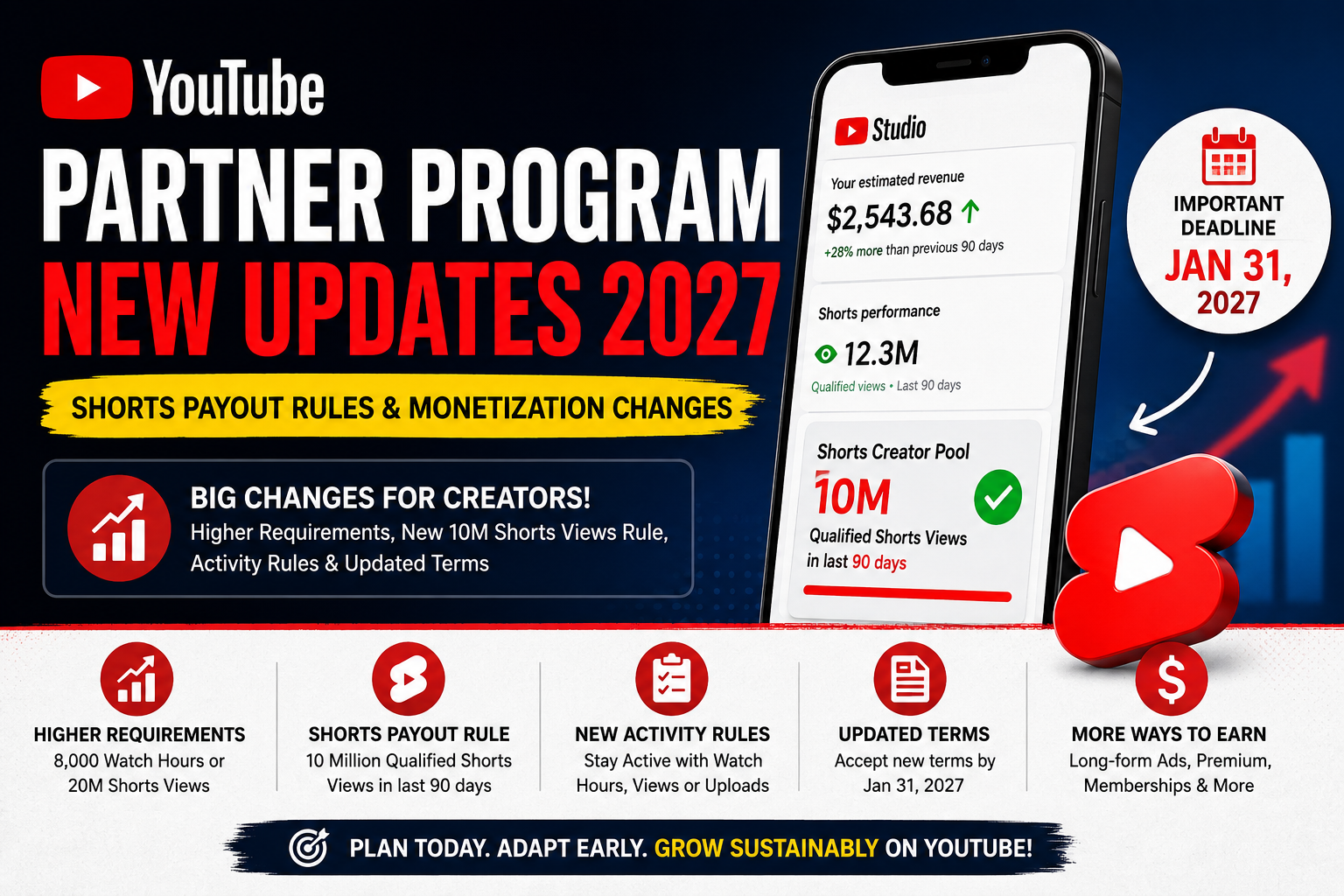
Starting February 1, 2027, YouTube plans to introduce higher entry requirements for ad-revenue monetization, a new monthly threshold for Shorts Creator Pool earnings, updated activity requirements, and new Partner Program terms that existing creators will need to accept.
For creators who rely heavily on YouTube Shorts, the biggest change is particularly important: channels will need 10 million qualified Shorts views within a rolling 90-day period to earn from the Shorts Creator Pool in a given month.
Here’s what YouTube creators, marketers, and businesses need to know.
What Is Changing in the YouTube Partner Program?
YouTube’s updated rules introduce several major changes from February 1, 2027.
The key changes include:
- Higher ad-revenue eligibility requirements for new creators
- A new 10 million qualified Shorts views / 90 days threshold for Shorts Creator Pool earnings
- New activity requirements for existing YPP channels
- Updated Partner Program terms
- A January 31, 2027 deadline for existing partners to accept the new terms
- Continued monetization opportunities for channels that do not meet the new Shorts threshold
- New potential incentive programs aimed at smaller Shorts creators
Importantly, these changes do not mean that every existing YouTube Partner Program channel will lose monetization immediately.
YouTube is separating eligibility for different monetization opportunities and introducing additional requirements around Shorts activity and earnings.
1. Shorts Creators Face a New 10 Million View Threshold
The most significant change for Shorts creators is the introduction of a monthly minimum for Shorts Creator Pool earnings.
Beginning February 1, 2027, a channel will need at least:
10 million qualified Shorts views during the previous 90 days
to earn from the Shorts Creator Pool for that month.
This is different from the current system, where monetizing creators who have accepted the Shorts Monetization Module can receive a share of Shorts revenue based on their eligible engaged views.
The new requirement uses a rolling 90-day window, meaning creators cannot simply reach 10 million views once and assume they will continue earning indefinitely.
Example
Imagine a Shorts channel has:
- November: 4 million qualified views
- December: 3 million qualified views
- January: 2 million qualified views
Total = 9 million views
That channel would be below the 10 million qualified-view threshold for the applicable month.
If the channel subsequently reaches 10 million qualified views within the rolling 90-day period, Shorts Creator Pool revenue sharing can resume.
According to YouTube’s updated information, channels that fall below the threshold can remain in the Partner Program and continue earning through other eligible monetization features, including long-form content.
2. What Exactly Is the Shorts Creator Pool?
Shorts monetization works differently from traditional YouTube video advertising.
With long-form videos, advertisements can appear directly on or around a specific video. Shorts use a feed-based advertising model, where ads appear between Shorts.
YouTube therefore pools Shorts Feed advertising revenue and distributes it among eligible creators.
The current Shorts revenue-sharing model works broadly as follows:
- Revenue from ads shown between Shorts is collected.
- A portion is allocated to the Shorts Creator Pool.
- Revenue is distributed according to creators’ share of eligible engaged Shorts views.
- Monetizing creators receive 45% of the revenue allocated to them.
Music licensing is also considered within the Shorts revenue-sharing system.
For example, revenue associated with Shorts using music can be divided between the Creator Pool and music licensing costs before creator allocations are calculated.
The new 10 million-view rule therefore adds another layer: a creator may have eligible Shorts views but still not qualify for Creator Pool earnings for a particular month if the rolling 90-day threshold is not reached.
3. New YouTube Partner Program Entry Requirements
YouTube is also increasing the requirements for new creators who want to qualify for ad-revenue sharing.
Currently, the primary ad-revenue route requires:
- 1,000 subscribers, and
- Either 4,000 valid public watch hours in the previous 12 months
- Or 10 million valid public Shorts views in the previous 90 days
From February 1, 2027, the thresholds are expected to become:
- 1,000 subscribers, and
- Either 8,000 qualified watch hours in the previous year
- Or 20 million qualified Shorts views in the previous 90 days.
In other words, the main ad-revenue thresholds are effectively doubling.
This could make it considerably harder for new channels to reach full advertising monetization.
What About Fan Funding?
The lower-entry YPP route for features such as fan funding and Shopping remains different.
YouTube’s expanded YPP eligibility currently specifies:
- 500 subscribers
- 3 valid public uploads within the last 90 days
- Either 3,000 valid public watch hours during the previous year
- Or 3 million valid public Shorts views during the previous 90 days.
The updated announcement does not indicate that these lower-tier requirements are being doubled in the same way as the main ad-revenue thresholds.
4. Existing YouTube Partners Need to Accept New Terms
Creators already participating in YPP should pay close attention to the new agreements.
Existing partners will have until:
January 31, 2027
to accept the applicable updated terms in YouTube Studio.
The agreements include:
- Watch Page Monetization Module
- Shorts Monetization Module
- Commerce Product Module, where applicable
Creators who miss the deadline will stop earning from the affected monetization features starting February 1.
However, YouTube says this does not automatically remove the channel from the Partner Program. Creators can regain access to the relevant monetization features after accepting the required terms.
This makes checking the Earn section inside YouTube Studio particularly important as the deadline approaches.
5. YouTube Is Also Introducing New Activity Rules
Another important change concerns inactive channels.
From February 1, 2027, YouTube plans to consider a channel active in YPP if it meets at least one of these conditions:
- 1,000 qualified watch hours during the previous year
- 1 million qualified Shorts views during the previous 90 days
- Uploads 2 long-form videos within 90 days
- Uploads 5 Shorts within 90 days
This creates a clearer activity framework for channels that remain in the Partner Program.
Creators who publish content regularly will therefore have multiple ways to demonstrate activity rather than relying exclusively on watch hours or Shorts views.
6. Original Content Is More Important Than Ever
Reaching the required number of views is not enough.
YouTube’s Shorts monetization policies state that monetizing creators must follow YouTube’s channel monetization policies, Community Guidelines, Terms of Service, copyright requirements, and AdSense policies.
Certain Shorts views may not qualify for revenue sharing.
Examples include:
- Reuploaded videos from other creators
- Unedited clips from movies or television
- Compilations without meaningful original content
- Artificial or fake views
- Content that does not meet advertiser-friendly guidelines
For creators building a Shorts strategy, this means originality and audience value are becoming increasingly important.
Simply producing large volumes of recycled clips may generate views, but it can create monetization problems.
7. Does Using Music Reduce Your Shorts Revenue Share?
YouTube’s Shorts system has a different approach to music than many creators assume.
The Creator Pool accounts for music licensing before creator revenue is distributed. However, YouTube says that once a creator’s eligible revenue allocation is calculated, the creator receives 45% of the allocated revenue regardless of whether music was used in the Short.
Therefore, creators should not assume that simply adding music automatically reduces their final creator revenue percentage.
The bigger issue is whether the Short itself is eligible for monetization.
8. What Happens If You Get Fewer Than 10 Million Shorts Views?
This is one of the most important questions for smaller creators.
Suppose your channel receives:
6 million qualified Shorts views over 90 days.
Under the new rule, you would not earn from the Shorts Creator Pool for that month.
However, that does not necessarily mean your entire YouTube monetization disappears.
You can still potentially earn from other eligible sources, including:
- Long-form video advertising
- YouTube Premium revenue
- Channel memberships
- Super Chat
- Super Stickers
- Super Thanks
- Shopping and other eligible monetization features
And if your Shorts channel later reaches the 10 million qualified-view threshold within the rolling 90-day period, Shorts Creator Pool earnings can resume.
9. YouTube Is Raising the Bar for Shorts Creators
The new rules represent an important shift in YouTube’s monetization strategy.
Shorts have become one of the biggest sources of video consumption on the platform. As competition increases, YouTube appears to be placing greater emphasis on:
- Original content
- Consistent publishing
- Qualified engagement
- Active channels
- Sustainable creator businesses
For creators, the lesson is simple:
Views alone should not be your entire YouTube strategy.
A channel that relies exclusively on Shorts may be more exposed to changes in Shorts monetization rules.
A stronger strategy can combine:
Shorts → Audience Growth → Long-Form Content → YouTube Premium → Memberships → Sponsorships → Products/Services
This creates multiple revenue streams instead of depending entirely on Shorts advertising.
10. What Creators Should Do Before February 2027
Creators should start preparing well before the new rules take effect.
1. Check YouTube Studio
Regularly check the Earn section for updated agreements and monetization notifications.
2. Review Your Shorts Analytics
Monitor:
- Qualified views
- Engaged views
- Watch time
- Audience retention
- Returning viewers
- Traffic sources
3. Focus on Original Content
Avoid building your channel around simple reposts, compilations, or minimally edited third-party videos.
4. Build Long-Form Content
If your channel currently depends heavily on Shorts, consider developing long-form videos around your most successful topics.
5. Diversify Revenue
Consider memberships, Super Thanks, Shopping, sponsorships, affiliate marketing, courses, services, or digital products where appropriate.
6. Don’t Ignore the January 31 Deadline
Existing YPP partners should make sure they review and accept the applicable new terms before January 31, 2027.
What This Means for Businesses and Digital Marketers
The changes are not only relevant to individual creators.
Businesses increasingly use YouTube Shorts for:
- Brand awareness
- Product demonstrations
- Local marketing
- Lead generation
- Educational content
- Customer testimonials
- Search visibility
- Community building
For businesses, Shorts should therefore be viewed less as a direct advertising-income source and more as a customer acquisition and brand-building channel.
A business does not need 10 million Shorts views to benefit from YouTube.
A targeted Short reaching 50,000 potential customers in the right market can potentially be more valuable than millions of views from an irrelevant audience.
This is particularly important for local businesses and service companies.
Final Thoughts
YouTube’s upcoming Partner Program changes represent one of the biggest adjustments to creator monetization in recent years.
Starting February 1, 2027, new creators will face higher thresholds for full ad-revenue eligibility, while Shorts creators will need 10 million qualified Shorts views in a rolling 90-day period to receive Shorts Creator Pool earnings for a month. Existing YPP partners will also need to accept updated terms by January 31, 2027.
The most important takeaway is that creators should not build their entire business around Shorts advertising alone.
The strongest YouTube strategy going forward will likely combine original Shorts, long-form videos, audience engagement, multiple monetization features, and revenue sources outside YouTube advertising.
For creators who start preparing early, these changes can be viewed not only as stricter requirements, but also as an opportunity to build a more sustainable YouTube business.